📋 Table of Contents
1. What Is a Cloud Phone System? 2. Cloud vs. Traditional Phone Systems 3. The 6 Key Benefits 4. Security & Compliance 5. Who Benefits Most from Cloud Telephony? 6. Costs & Pricing Models 7. How to Choose the Right Solution 8. Frequently Asked QuestionsThe way businesses communicate has fundamentally changed. Where a physical PBX once sat in the server room, today all you need is an internet connection and a browser. Cloud phone systems replace expensive hardware with flexible software – enabling businesses of any size to communicate professionally and cost-effectively.
This guide is written for founders, IT managers, and operations leaders who want to make an informed decision about their business phone infrastructure.
1. What Is a Cloud Phone System?
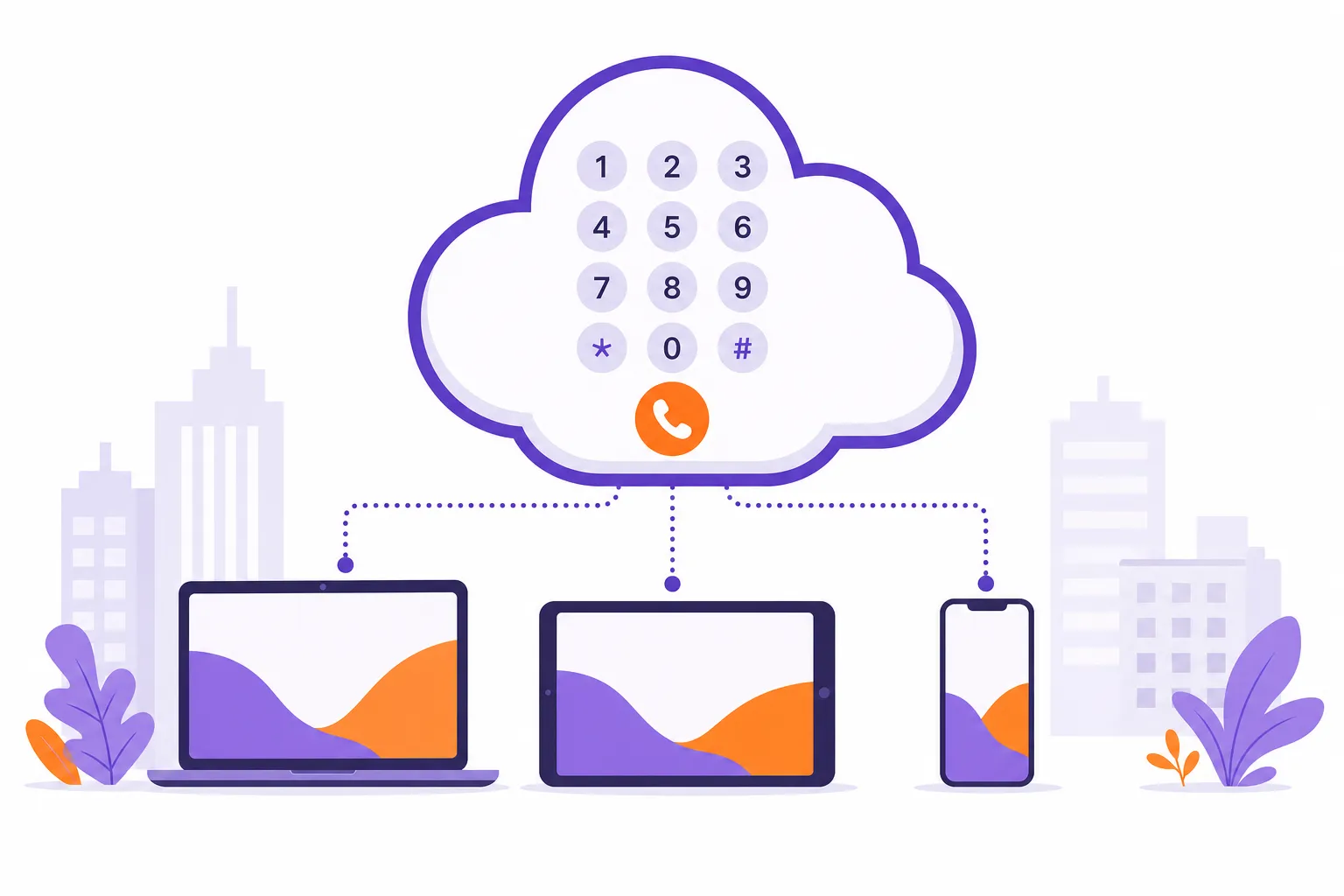
A cloud phone system (also known as cloud PBX, hosted PBX, or virtual phone system) is an internet-based telephony solution that runs entirely in the cloud. Unlike traditional phone systems, it requires no physical hardware on-site – no wiring, no servers, no maintenance contracts.
Technically, cloud phone systems rely on VoIP (Voice over Internet Protocol): voice is converted into data packets and transmitted over the internet. Modern solutions use WebRTC (Web Real-Time Communication), a technology built directly into web browsers. This means phone calls can happen without any software installation – directly from Chrome, Firefox, Safari, or Edge.
In practice, it works like this: an employee opens their browser, signs in, and can immediately call any landline or mobile number in over 200 countries worldwide. No IT ticket, no installation process, no waiting.
💡 Quick note: The terms "cloud phone system," "VoIP phone system," "virtual phone system," and "hosted PBX" are often used interchangeably. While there are technical differences (e.g., an IP phone system can also run on-premise), in everyday usage they all refer to the same thing: internet-based business telephony.
2. Cloud Phone System vs. Traditional PBX
Choosing between cloud and on-premise is one of the most fundamental IT decisions for any business. Here are the key differences:
| Criteria | Traditional PBX | Cloud Phone System |
|---|---|---|
| Upfront costs | High (hardware, installation, wiring) | Low to none |
| Monthly costs | Maintenance + call charges | Usage-based or subscription |
| Setup time | Weeks to months | Minutes to hours |
| Scalability | Limited by hardware | Instantly scalable |
| Remote-ready | Only with VPN / add-ons | Works from anywhere |
| Maintenance | In-house IT or contractor | Handled by provider |
| International calls | Expensive via carrier | Affordable via VoIP |
| Hardware required | IP phones, servers, switches | Just a PC, laptop, or phone |
| Updates | Manual, often paid | Automatic, included |
| Redundancy | Depends on local hardware | Redundant cloud servers |
For most businesses – especially SMBs, remote teams, and companies operating internationally – a cloud phone system is the more economical and flexible choice in 2026. Traditional systems still have a place in environments with strict compliance requirements or existing, fully depreciated infrastructure.
3. The 6 Key Benefits of a Cloud Phone System
Lower Costs
No hardware investment, no maintenance fees. International calls cost a fraction of traditional rates. Many providers offer transparent prepaid or subscription models with no hidden fees.
Instantly Scalable
New employee? New team? Additional lines are set up in minutes in the cloud – not weeks. Scaling down is just as easy when the need arises.
Work from Anywhere
Office, home, airport – cloud telephony works wherever there is an internet connection. Essential for distributed teams and remote-first companies.
Quick Setup
No technician visit, no wiring. Browser-based solutions are ready in under 5 minutes – create an account, sign in, start calling.
Zero Maintenance
Updates, security patches, and infrastructure are handled by the provider. Your IT team can focus on what actually drives your business forward.
Integration-Ready
Modern cloud phone systems connect with CRMs, helpdesk tools, and project management platforms – creating seamless communication workflows.
4. Security & Compliance
Security is a valid concern when it comes to cloud telephony. Voice data travels over the internet – that demands robust protection. Reputable providers address this with multiple security layers:
🛡️ Technical Protection
Encrypted connections, access controls, and continuous security monitoring protect against unauthorized access and data breaches.
⚠️ Anti-Fraud Systems
Automatic anomaly detection prevents misuse and toll fraud in real time – an underestimated risk with any VoIP system.
🔒 Encrypted Communication
TLS for signaling and SRTP for voice data ensure that call content remains protected during the entire transmission.
🏛️ Compliance & Data Residency
Providers with data centers in your region help meet GDPR, CCPA, and other regulatory requirements. Ask where your data is stored and processed.
⚠️ What to watch for: Ask potential providers directly about server locations, encryption methods, and whether they offer a Data Processing Agreement (DPA). Providers who are not transparent about these details should be approached with caution.
5. Who Benefits Most from a Cloud Phone System?
Cloud telephony is not a one-size-fits-all solution. These are the scenarios where it delivers the most value:
Sales Teams
Outbound calls to international clients and partners without expensive long-distance rates. Especially valuable for B2B companies with customers across multiple countries.
Customer Support
Global reachability for international customers. Integration with helpdesk systems for seamless documentation and ticket management.
Remote Teams
Distributed employees use one unified system – regardless of location or device. Browser-based solutions require zero local installation.
Agencies & Freelancers
Professional communication without heavy infrastructure. Flexible costs that grow with your business – no long-term commitments required.
E-Commerce & Online Retail
Coordinate with overseas suppliers, handle customer inquiries – all through one system. Particularly useful when sourcing from Asia or Eastern Europe.
Startups & SMBs
Professional telephony from day one – without capital expenditure. Scales with your company without ever needing to rebuild your infrastructure.
Try Cloud Telephony – No Contract Lock-in, No Installation
200+ countries reachable, from €0.03/min, directly in your browser. Prepaid from €10, no commitment.
Create Your Free Account →6. Costs & Pricing Models
The cost of a cloud phone system varies significantly depending on features, provider, and billing model. Here are the three most common pricing structures:
Subscription Model (per user/month)
The most common model for full-featured business phone systems. Typical cost: €10–30 per user per month. Usually includes a set number of minutes, with per-minute charges beyond that. Advantage: predictable expenses. Disadvantage: fixed costs even during low-usage months.
Prepaid Model (pay-as-you-go)
Top up your balance, pay only for what you actually use. No monthly fees, no contract lock-in. Ideal for businesses with fluctuating call volume or those just getting started with international telephony.
Enterprise Packages (custom pricing)
For larger organizations with specific requirements: custom rates, dedicated connections, SLA agreements, and dedicated support. Pricing on request.
| Pricing Model | Typical Cost | Contract | Best For |
|---|---|---|---|
| Subscription | €10 – €30/user/mo | Monthly cancellation | Teams with steady call volume |
| Prepaid | From €10 credit | No contract lock-in | Flexible needs, getting started |
| Enterprise | Custom | Annual contract typical | Large teams, specific needs |
💡 Tip: When calculating total cost, look beyond the base price. Factor in per-minute rates for international calls, setup fees, and charges for additional features. Transparent providers make it easy to understand the full picture upfront.
7. How to Choose the Right Cloud Phone System
The cloud phone market is growing rapidly. To find the right provider, evaluate these key criteria:
Call quality: HD voice and stable connections are non-negotiable. Ask about the underlying technology – WebRTC offers the best browser integration – and test quality before committing.
Data residency & compliance: For businesses handling sensitive data, knowing where servers are located and how call data is processed is critical. Request a Data Processing Agreement (DPA).
International coverage: How many countries are supported? Are there separate rates for landline and mobile? Transparent pricing pages are a good sign.
Setup complexity: Does it require software installation? Do you need specific hardware? Browser-based solutions offer the lowest barrier to entry – no downloads, no OS dependency.
Contract terms: Monthly cancellation, no hidden fees, no minimum volume. Prepaid models offer maximum flexibility for businesses that want to stay agile.
Support: How responsive is the provider? Is support included in the price or charged separately? Is support available in your language and time zone?
Security: Encryption, anti-fraud systems, and regular security audits should be standard – not a paid add-on.
FluffyCall – Cloud Telephony Directly in Your Browser
No installation, no contract lock-in, EU servers. 200+ countries, prepaid from €10.
Try It Now →Related Topics
📚 Deep-Dive Articles on Cloud Telephony:
📖 Also worth reading:
Cheap International Calls – All 5 Methods Compared →Frequently Asked Questions
What is a cloud phone system?
A cloud phone system is an internet-based phone solution that replaces traditional on-premise hardware. It uses VoIP to transmit calls over the internet. Users can make calls via browser, app, or IP phone – no physical PBX required.
How much does a cloud phone system cost?
Costs vary by provider and model. Subscription-based systems typically charge €10–30 per user per month. Prepaid solutions offer credits starting from €10 with no monthly fees or contracts.
Is a cloud phone system secure?
Yes, when the provider follows modern security standards. Look for TLS/SRTP encryption, anti-fraud systems, data center locations in your region, and compliance with regulations like GDPR or CCPA.
Do I need special hardware?
No. Most cloud phone systems work with existing devices – computers, laptops, tablets, or smartphones. Browser-based solutions only require a modern web browser.
Cloud vs. traditional PBX – which is better?
Cloud phone systems are more flexible, cheaper to deploy, and ideal for distributed teams. Traditional PBX offers maximum control but requires significant investment. For most businesses in 2026, cloud is the better choice.
Can I make international calls?
Yes. International calling is one of the biggest advantages of cloud telephony. Rates are significantly lower than traditional carriers. Browser-based solutions like FluffyCall reach over 200 countries worldwide.